Do you want to send us your book files? We prefer not to use email, which has file size limits, and it is hard to keep track of different file versions as the book progresses. That's why we appreciate Dropbox: it gives us a way to share a file folder with our client, containing all the files of a book project. Dropbox keeps data on their "cloud" server so that people who share a folder can view, access, and change the shared files.
If you have a Dropbox account and already know how to share a folder, send us one. But if you haven't used Dropbox before, we will send you an invitation and get you started. It's easy to set up your free account, and once you have it, you'll appreciate its usefulness, too! Here is how it works:
1. You'll receive our invitation in an email sent from Dropbox.

2. The email will contain a link to the folder we've created for you. Click on it.
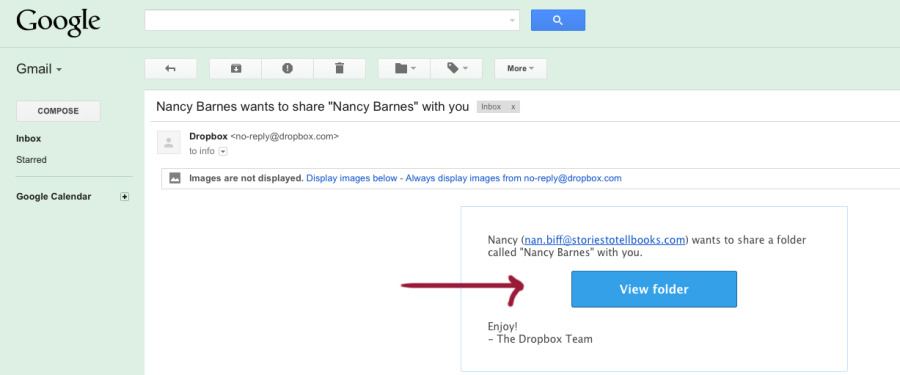
3. This will take you to the Dropbox site, where you will create your free user account.
 4. Next, you'll download the Dropbox to your computer. You might choose the web option if you travel a lot, but if you're going to be collaborating on the book project, it's easier to have it right on your computer.
 5. Open and install the program as prompted, just as you do all programs on your computer. When Dropbox opens, you'll see our shared folder (see the icon of two people on the folder?) with your name on it.
 6. Click on the shared folder to open it. It's only an empty folder; your job is to put your book files into it.
 7. It's easy to add your files to the folder. As you see in the image above, you can click on the links to the desktop application or the web uploader - either will work. Or you can simply select and drag them from their current folder to the Dropbox using Windows Explorer (PC) or the Finder (Mac). Or you can use the same methods you use to copy files ordinarily - by selecting, then right clicking to copy, or by using the pull-down menu "copy" command. Copy to make duplicates into our shared folder in the Dropbox, and keep your originals in a different folder.
Can't find your Dropbox folder? On a PC, it is located in your "My Documents" folder. On a Mac, look in your user folder. I recommend creating a shortcut to easily access Dropbox from your taskbar/menu bar.

8. That's it! Once your files are in the shared folder, send us an email or call to let us know you're ready to have us take a look at them.
Like Google search, I can't understand how I ever lived without Dropbox. Now all my files are backed up online, so I'll never lose anything if a computer fails or my house burns down. And all my files are current and synchronized on my various computers, smartphones, and my ipad. You can learn more about Dropbox here: https://www.dropbox.com/tour.
“Readers tend to skip along through novels,” said Elmore Leonard, “but, they won’t skip dialogue.”
That’s particularly true if you write crisp, clipped,rhythmic dialogue like Leonard does in his quirky, hardboiled, crime and suspense novels. Let’s look at some advice from the master on some ways to improve the dialogue you write.
Leonard acknowledges the influence of jazz on his own writing and says, “Try to get a rhythm” when writing dialogue.
Part of maintaining a rhythm is avoiding anything that interrupts it. Let’s at some easy ways to do that.
Read More
It’s called publishing, but sometimes you don’t want a publisher. You want to self-publish by putting the book online to be sold, or you want a printer to ship you a box of books. We offer a service that solves both problems, and we call it simply a “Printer Setup.” (Even when we’re setting you up for Amazon sales. They’re a printer, too.) We use our knowledge of the printing and publishing industry to locate the best resources. And we use our technical knowledge about book files to make sure your book is published, trouble-free, and that it looks good in print.
In fact, our “Printer Setup” service is a multi-step process, and it depends on your goals for your books. Essentially, it boils down to 1) identifying what you really need, 2) choosing the printer or online distributor that’s right for you, 3) setting up the account 4) preparing your files for the printer, 5) submitting the files and dealing with the printer on your behalf.
Read More
New York Times columnist Bruce Feiler asked himself, “What is the secret sauce that holds a family together? What are the ingredients that make some families effective, resilient, happy?” The answers he discovered appeared in a piece in the Sunday Times titled The Stories That Bind Us. It should be required reading for genealogists and family historians.
Feiler consulted Emory University psychologist Marshall Duke who had explored myth and ritual in American families. What he learned was that, “The more children knew about their family’s history, the stronger their sense of control over their lives, the higher their self-esteem and the more successfully they believed their families functioned.”
Read More
Today, we welcome award-winning indie sci-fi and paranormal author Roland Allnach. Roland’s short story Creep was a 2010 Pushcart Prize nominee. His book, Remnant was a finalist for the 2011 National Indie Excellence Award, a 2012 Bronze Medalist in the Readers Favorite Awards and received recognition in the 2012 USA Book News Best Book Awards. His anthology Oddities & Entities was also recognized by the 2012 Readers Favorite Awards.
We are happy to present Roland’s Thoughts on Marketing Considerations.
Read More
We deal with printers all the time. Every book we make has a destination: perhaps into the hands of a consumer, or perhaps to a darling grandchild. Our goal is to match our authors with the right printer for their needs. There are many printers offering an array of features, and we’ll examine the options here.
As an author, you are concerned about how to get your book into print, within your budget. For commercial books, the goal is to keep costs down. However, if you are printing a book for family and friends, you may want to pay more for higher quality, longer lasting book.
Read More
Today we are happy to welcome Dr. Bill Smith who is stopping by on his blog tour for the new edition of his book The 13 Ways to Tell Ancestor Stories.
Dr. Bill has written nine nonfiction books about family history, serves as a Squidoo lens master, contributes to The In-Depth Genealogist as The Heritage Tourist and writes a newspaper column on family history. We’re happy to have had an opportunity to chat with Dr. Bill about his latest project.
Here’s our interview with Dr. Bill:
Read More
Maureen Taylor, the internationally known photo identification expert and photo historian whom the Wall Street Journal called The Photo Detective has a wonderful new project. Ten years ago she discovered over 200 photo images of men and woman who were alive during the Revolutionary War and survived into the photographic age. The discovery led to two books, The Last Muster (Kent State University Press, 2009) and The Last Muster: Faces of the Revolution (soon to be released).
Now Maureen is partnering with Verissima Productions of Cambridge, Massachusetts to create a documentary film, Revolutionary Voices, to bring the faces and the stories behind them to life.
The documentary has an ambitious $225,000 budget. Maureen and her partners are using Kickstarter, a platform to crowd source funding for creative projects, to get financing underway Revolutionary Voices.
We had an opportunity to talk with Maureen about the project during the recent Roots Tech 2013 Conference in Salt Lake City.
Read More
Imagine what your book will look like when it’s finished. It’s the first step in the author’s journey and in many ways the most important.
We’ve just spent three days at RootsTech 2013, a huge conference combining genealogy, family history, storytelling and technology. It seemed that nearly everyone of the thousands in attendance has a story that they want to tell.
Of the many who stopped by the Stories To Tell booth to talk came with questions beginning: “Is it okay if I…” or simply “Can I…?”
Absolutely! Whatever you can imagine, you can do. Conceiving of a book that is unique is a creative act. That’s what any author should be striving for. There are no rules about what your book must contain or how it must look. Your family’s history is unique and the way you capture it in a book should be unique too.
Read More
“One in three children admit they don’t want to listen to their grandparents because they find them ‘boring,’” said The Mail Online reporting on a poll taken by print on demand publisher Blurb.com. “42% of parents say children tune out when elders start to speak about the past.”
That’s a real challenge for anyone working on a family history book. The vast majority of those authors say they want to write a book to preserve the family history for the grandchildren.
How can a family historian make sure she captures the grand children’s interest? One important way is to recognize the difference between researching and recording the family history and telling the family story.
Read More
Writing a book is a creative challenge, but getting it into print is a technological one.
As we prepare for RootsTech, the annual conclave in Salt Lake City, which blends genealogical and family history research, storytelling and the latest and greatest technology tools, it seems like a good time to look at the dual challenges of creating a book.
The graphic below traces the author’s journey through the creative process and the technological tools that are required to produce a professional quality book
Read More
It’s only a week until a crowd of genealogists, family historians and a wide array of geeks converge on the Salt Palace in Salt Lake City for the RootsTech Conference.
Attendees from around the country (and the world) are honing the questions they want to pose to the experts. One question that many participants want answered is, “What’s the best way to preserve family stories and pass them on to future generations?” The answer is multi-faceted.
Read More
Are you looking for a printer or publisher for your book? Choosing the right one is one of the most important decisions an author needs to make on the way to publication.
Here are ten questions to consider in choosing your book’s path into print.
Read More
You want to write a factually accurate family history, but you want it to be interesting. You are facing a conundrum that confronts many genealogists when the decide to turn their research into a book.
There are rules to follow to insure that your book is factually accurate. The best guideline is the one created by the Board of Certification for Genealogists in its Genealogical Proof Standard which advises:
Read More
We are in Tucson, Arizona this weekend for the Tucson Festival of Books. It’s always a great event.
One of the topics I know we’ll be discussing with authors is e-books. It seems like everybody wants their book in digital format.
If you are making decisions about the best publishing format for your book – e-book, print book or both – here are some things to consider.
Read More
If you are an author aiming for commercial success you must approach your book as a business person would. Your book is, after all, a product you wish to sell. One of the first questions to consider is, how have similar books done in the marketplace?
Michael Larsen, a partner in Larsen-Pomada Literary Agents wrote in Katherine Sands’ excellent book Making the Perfect Pitch:
“The moment you have an exciting idea for a book…
• Check the competition
• Make yourself an expert on your subject by reading the most important competitive books and browsing through others.”
Read More
The draft of the book you plan to self-publish is finished. Your beta readers have offered good feedback on the book’s content. You have revised and edited the manuscript until it’s as polished as you can make it. You are ready to send the files off to the printer. But wait! It needs a thorough careful copy edit before it goes anywhere.
“Copyediting is what turns an amateurish book into a polished, professional one,” says bestselling author Guy Kawasaki in his new book on self-publishing, APE: How to Publish a Book...Here are seven ideas that will improve your copy editing.
Read More
Who will edit the manuscript for your self-published book? If you haven’t thought about the question you should.
There were 347,178 new print books published in 2011, the last year for which complete figures are available. With ebooks added the number probably approaches half a million. How will your book stand out from that torrent of others?
You might begin to answer that question by thinking about a slogan Ford used in its advertising a few years ago, Quality is Job One! How will you assure that your manuscript is of the highest quality it can be? The simple answer is, make sure it is well-edited.
Read More
You have had an interesting life; maybe dramatic, maybe traumatic, maybe even tragic. You want to share it with a large audience in a memoir.
To be successful you will ultimately have to confront what Richard Gilbert, in his blog Narrative, calls “the ‘so what’ dilemma.”
No matter how remarkable the life story you have to tell, Gilbert explains, your reader will be likely to filter your experience through a series of questions, “’So what?’ That is, why should we care about your life? Why should we care what you think?”
The paramount quality which makes a memoir great is not the uniqueness of the incidents it recounts, but the depth of the insights it draws from them.
Read More
Print books are going away in record numbers, but not in the way you think.
In fact, Bowker Research’s 2012 Report on Print Book Publishing indicated that print titles published rose 6% to 347,178 in 2011 with another 1.1 million published titles of reprinted public domain works.
That’s a lot of books.
Reporter Claire Lawton of the Phoenix New Times in an article titled Disappearing Ink investigated what happened to those books when no one wants to read them any longer. It’s a fascinating piece.
Read More